
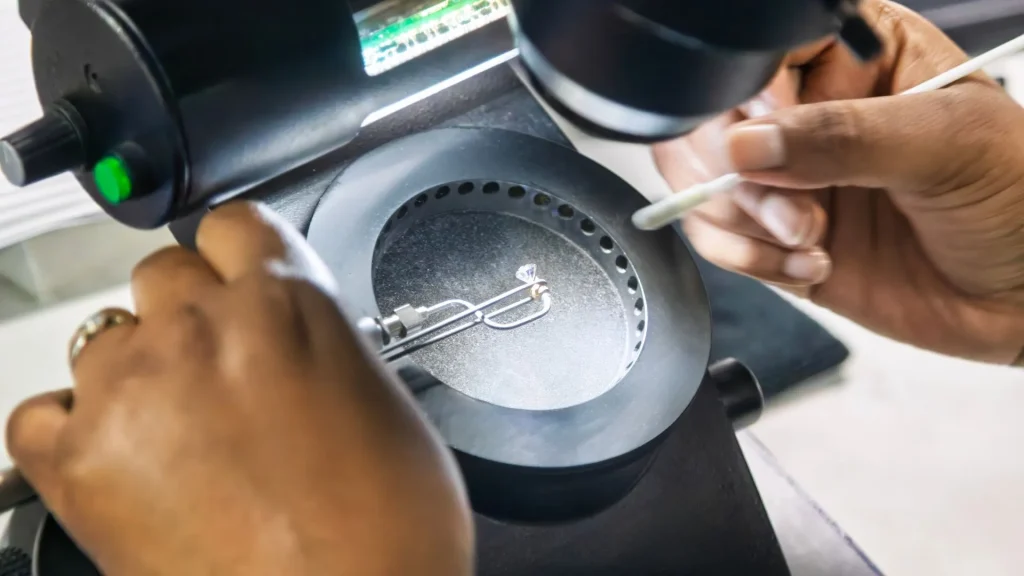
A diamond grading report is an independent laboratory document that identifies a diamond and records its measurable quality characteristics. Depending on the laboratory and report type, it may include carat weight, color, clarity, cut information, measurements, polish, symmetry, fluorescence, and identifying features. The report does not assign a resale price, but it can make a diamond easier to verify, compare, and evaluate when selling.
If you want to see how Las Vegas Jewelry & Coin Exchange approaches diamond buying and evaluation, you can also review their Diamond Information page.
Key Takeaways
- The 4Cs of diamonds include carat weight, cut, color, and clarity.
- GIA grading reports are considered one of the most widely recognized diamond certifications worldwide.
- Many diamonds between 0.50 and 2.00 carats commonly appear in engagement rings sold in the resale market.
What Is A Diamond Grading Report?

A diamond grading report is a document issued by a gemological lab that records the diamond’s key identifying and quality characteristics. A diamond grading report typically includes the 4Cs and additional details like measurements, finish, fluorescence, and comments, depending on the lab and report type.
A diamond grading report is not the same as a receipt, and it is not a guarantee of what a buyer will pay. It is best viewed as a technical “passport” that helps identify the diamond and describe it consistently.
Why Does A Diamond Grading Report Matter When You Sell A Diamond?
When you sell a diamond, the buyer needs to verify that the stone matches the description being presented. A diamond grading report can reduce uncertainty, speed up evaluation, and minimize misunderstandings because it provides standardized language for the diamond’s quality factors.
It can also help separate facts from assumptions. Many sellers only know what they paid at retail, but retail pricing and resale offers often differ, so using the this report keeps the discussion grounded in verifiable characteristics.
If you’re selling a ring (not just a loose stone), the buyer may also evaluate the setting metal and overall piece condition as part of the offer. Learn more about selling your jewelry on our Fine Jewelry page.
What Is Usually Included In A Diamond Grading Report?
Most diamond grading formats include the 4Cs plus supporting identification fields. If you only learn a few sections, focus on the parts that are easiest to confirm and most likely to affect value and buyer confidence.
Here is what you will commonly see:
- The 4Cs (Carat, Color, Clarity, Cut).
- Shape and cutting style (for example, round brilliant vs fancy shapes).
- Measurements (length/width/depth in millimeters).
- Finish details such as polish and symmetry.
- Fluorescence description.
- A report number (unique identifier).
- Sometimes a clarity plot diagram and comments, depending on report type.
What Are The 4Cs On A Diamond Grading Report?
The 4Cs are Carat, Color, Clarity, and Cut. A report lists these so buyers can compare diamonds using a shared standard rather than informal descriptions.
Even if you are not a gemologist, knowing the 4Cs makes it easier to communicate clearly when you request an offer. Learn more at Las Vegas Jewelry and Coin Exchange.
What Does Carat Mean On A Diamond Grading Report?
Carat refers to the diamond’s weight, not its face-up size. Your diamond grading report will list carat weight to a high precision, which helps distinguish stones that look similar.
When sellers compare diamonds, carat is often the first number they notice, but carat alone does not determine value without the other quality fields on the diamond grading report.
What Does Color Mean On A Diamond Grading Report?
Color grading typically describes how colorless a diamond appears under controlled grading conditions. A diamond grading report will list a color grade on a scale used by that lab.
Two stones can have the same carat weight but different color grades, and that difference can influence how a buyer evaluates the stone in person.
What Does Clarity Mean On A Diamond Grading Report?
Clarity describes internal and external characteristics, often called inclusions and blemishes. A diamond grading report may include a clarity grade and a diagram that maps notable characteristics.
This matters for selling because clarity characteristics can influence appearance, desirability, and how easy it is to match the report to the actual diamond.
What Does Cut Mean On A Diamond Grading Report?
Cut is about how well the diamond is proportioned and finished, which affects light return and brilliance. Many sellers assume “cut” means only the shape, but on a diamond grading report, cut is a quality grade category.
Some grading systems apply a formal cut grade only to certain shapes and grading ranges, so your diamond grading report may show cut information differently depending on the stone.
What Other Fields On A Diamond Grading Report Should Sellers Pay Attention To?
Beyond the 4Cs, a diamond grading report often includes measurements, polish, symmetry, and fluorescence. These fields can matter because they influence appearance, identification, and sometimes buyer preference.
If you are selling, the goal is not to memorize every field. The goal is to understand which sections are easy to confirm, and which ones can explain why one diamond gets a higher offer than another.
What Do Polish And Symmetry Mean On A Diamond Grading Report?
Polish describes the quality of the diamond’s surface finishing, and symmetry describes how well the facets align and match. Many diamond grading report formats include these as separate grades.
In practical terms, polish and symmetry help explain how refined the stone’s craftsmanship is, which can support buyer confidence, especially when the stone is being compared against other diamonds.
What Does Fluorescence Mean On A Diamond Grading Report?
Fluorescence describes how a diamond reacts to long-wave ultraviolet light, and it is commonly described on reports using levels such as None, Faint, Medium, Strong, or Very Strong. For sellers, fluorescence is best treated as a real factor that may or may not affect appearance depending on the stone.
If you see fluorescence listed on your diamond grading report, mention it, but do not assume it automatically makes the diamond “good” or “bad.” If you want a buyer-facing, practical description of what affects diamond desirability during selling, TopVegasBuyer’s Diamond Info page is a helpful reference.
What Is A Report Number On A Diamond Grading Report?
A report number is the unique identifier that connects the paper report to the lab’s record of that diamond. This number matters because it helps a buyer verify the report and check that the paperwork you bring matches the stone you are selling.
If you have the diamond grading report, do not rely on memory for the report number. Bring the original document or a clear photo so the number is accurate.
What Is A Laser Inscription, And How Does It Relate To A Diamond Grading Report?
Some diamonds are laser inscribed, meaning a microscopic inscription is placed on the diamond’s girdle. GIA explains that it can microscopically inscribe the diamond’s unique GIA report number on the diamond’s girdle, the inscription is not visible to the naked eye, and it can be viewed under 10× magnification.
This matters for selling because a laser inscription can make it easier to match the diamond to the diamond grading report, especially when the stone is loose or when there is uncertainty about which report belongs to which diamond. It can also help reassure you during cleanings, repairs, or re-mounting because it helps identify the stone you brought in.
How Can I Check If My Diamond Has A Laser Inscription?
You usually cannot see a laser inscription without magnification. A buyer may use a loupe or microscope to view the girdle and confirm whether the report number or other inscription is present.
If the inscription is present, it often includes the report number, which helps link the diamond back to the diamond grading report record.
What Is A Diamond Plot On A Diamond Grading Report, And Do I Need To Understand It?
Some diamond grading report types include a plotted diagram that maps clarity characteristics, essentially a “fingerprint” of inclusions and blemishes. You do not need to interpret the plot like an expert, but it helps explain how the clarity grade was determined and how the diamond can be identified.
For selling, the most useful approach is simple. Bring the diamond grading report, and ask the buyer to confirm whether the plot and characteristics align with the stone you brought in.
What Is The Difference Between A Diamond Grading Report And An Appraisal?
A diamond grading report describes the diamond’s measurable quality characteristics. An appraisal often assigns a monetary figure, sometimes based on retail replacement logic for insurance, which can differ significantly from resale offers.
If you bring only an appraisal, a buyer may still need to test and evaluate the stone. If you bring a diamond grading report, the conversation usually starts with clearer technical information.
If this difference has ever confused you, TopVegasBuyer has a direct explainer: Insurance vs. Selling Appraisals.
Does A Diamond Grading Report Tell Me What My Diamond Is Worth?
No. A diamond grading report describes quality factors, but it does not set a resale price. The offer you receive depends on market demand, the stone’s current condition, how it presents in person, and how the buyer intends to resell it.
A useful way to think about it is this: the diamond grading report helps identify and describe the diamond, while the market determines what buyers are willing to pay today.
What If I Lost My Diamond Grading Report?
If you lost your diamond grading report, you can still sell your diamond. The buyer will simply need to do more verification during evaluation, and the process may take a little longer.
If you remember the lab and the report number, bring that information. If you do not remember it, bring the stone anyway and ask the buyer to walk you through the testing and evaluation process, which is the kind of transparency TopVegasBuyer describes in their local appraisal content.
Can I Replace A Lost Diamond Grading Report?
Some labs provide ways to verify existing reports, and a buyer can sometimes help you determine whether your stone matches a record. If the report cannot be recovered, the other option is to have the diamond re-submitted for grading, which is a separate process with time and fees.
If your goal is to sell quickly, it may be more practical to sell based on an in-person evaluation first, then decide later whether you want to pay for re-grading.
What If My Diamond Grading Report Is Old?
Older reports can still be helpful, especially if the report number is verifiable and the diamond has not changed. However, diamonds can get chipped, abraded, or re-cut over time, and settings can be modified, so a buyer may confirm that the diamond’s current condition still aligns with the report.
Bring the report anyway, because even older documentation can make the evaluation process smoother.
What If The Diamond Is Mounted In A Ring?
You can still use a diamond grading report when the stone is mounted. The report can help a buyer understand what the stone is supposed to be, and the buyer can verify what they can see and measure while the diamond remains set.
If the setting blocks key viewing angles, the buyer may explain limits of what can be confirmed without removing the diamond. A transparent buyer should clearly tell you what they can confirm in-setting versus what would require removal.
What Should I Bring With A Diamond Grading Report When Selling?
Bring your diamond grading report, any receipts, any prior appraisals, and the ring box if you still have it. If you are selling an engagement ring, bring any paperwork that mentions side stones, brand details, or upgrades, because those may not be fully described in the main diamond grading report.
Being prepared helps the appointment go faster and makes the evaluation smoother, which aligns with TopVegasBuyer’s guidance on in-person appraisal expectations. If you want to schedule or confirm hours before visiting, use the Contact page.
What Should I Expect During A Buyer’s Diamond Evaluation?
A buyer will usually inspect the stone, confirm it is a diamond, and assess quality factors that align with the diamond grading report. They may also evaluate the setting metal and overall condition of the ring.
If you want the process to feel more transparent, ask one direct question: ask the buyer what they are confirming from the diamond grading report, and what they are verifying directly from the stone. If you want a broader view of how jewelry evaluations work in Las Vegas, TopVegasBuyer’s Jewelry and Coin Appraisal in Las Vegas guide is a useful reference.
What Are The Biggest Mistakes Sellers Make With A Diamond Grading Report?
One common mistake is assuming a diamond grading report guarantees a specific resale price. Another mistake is confusing an insurance appraisal value with what a buyer will pay, which TopVegasBuyer highlights when explaining the difference between insurance and selling appraisals.
A third mistake is bringing paperwork that does not match the stone being sold, especially with inherited jewelry. If you have multiple pieces, keep each diamond grading report paired with the right ring, box, or tag so nothing gets mixed up.
How Can I Use My Diamond Grading Report To Get A Better Selling Experience?
Use the diamond grading report to make the conversation easier. When you call or visit, you can share the report number and the 4Cs from the diamond grading report, then ask what the buyer will need to see in person.
You can also use your diamond grading report to organize your selling appointment. Bring the report, bring the ring, bring any matching paperwork, and be ready to answer basic questions like whether the diamond is natural or lab-grown if you know.
If you want to see what the buyer typically focuses on for diamonds and diamond jewelry, TopVegasBuyer’s Diamond Info page helps frame what matters during evaluation.
What Should I Do If I Suspect My Diamond Grading Report Is Fake?
If something looks off—like mismatched fonts, unclear printing, missing security elements, or a report number that cannot be verified—treat it as a red flag. A reputable buyer can still evaluate the stone itself, but the paperwork may not be reliable.
The best approach is to focus on what can be confirmed from the diamond and the setting, then decide whether you want to pursue re-grading through a recognized lab.
What Else Should I Sell Together With My Diamond?
If you are selling a diamond ring, you may also have gold or platinum in the setting, plus other jewelry you no longer wear. Consolidating items into one visit can be convenient, and a buyer can evaluate each category separately.
If you also have silver, watches, or coins, bring them in a separate bag with any paperwork so they can be evaluated efficiently during the same appointment.
Ready to get a free appraisal? Visit Top Vegas Buyer in Henderson.
Frequently Asked Questions
What Is The Most Important Part Of A Diamond Grading Report When Selling?
Can I Sell A Diamond Without A Diamond Grading Report?
Yes. You can sell without a diamond grading report, but the buyer will need to do more testing and verification before making an offer. If you want to make the process faster, bring any supporting documents you do have (receipts or appraisals) and ask what can be confirmed in-setting versus what requires removal.
Does A Diamond Grading Report Tell Me The Price Of My Diamond?
No. A diamond grading report describes characteristics, but the offer depends on market demand, condition, and what the buyer confirms during evaluation. If you’re comparing your insurance appraisal to resale reality, read Insurance vs. Selling Appraisals to avoid retail replacement confusion.
Should I Trust An Appraisal More Than A Diamond Grading Report?
Should I Bring My Diamond Grading Report If The Diamond Is Set In A Ring?
Yes. Bring the diamond grading report even if the diamond is mounted, because it can still help a buyer verify details and streamline the evaluation. If you want to contact Las Vegas Jewelry & Coin Exchange before visiting, use their Contact page.